Your analysts are shipping twice the analysis volume. Queries that used to take a day take an hour. Dashboards go out same-day. But still the quality of business decisions made from that analysis is indistinguishable from six months ago.
This is not hypothetical. McKinsey's 2025 State of AI survey, covering nearly 2,000 organisations, found that although 88% had adopted AI in at least one business function, only 39% reported any enterprise level EBIT impact. Similarly, the widely cited MIT analysis of 300 public AI deployments concluded that 95% produced no measurable P&L impact despite substantial investment.
Individual productivity and enterprise productivity are not the same thing. AI has made it easy to confuse the two. Closing the gap between them is the most important capability question analytics leaders need to answer right now.
Why individual gains do not cross over
At the individual task level, the evidence is compelling. Controlled studies consistently show AI improving productivity in areas such as customer service, software development, and content generation. Across industries and functions, workers complete specific tasks faster and often with higher quality.
At the firm level, the gains often disappear because enterprise performance is constrained by bottlenecks, not average productivity. An hour saved at a non-bottleneck step produces no throughput gain. In many organisations, AI accelerates content production, analysis, or code generation while the real constraint remains downstream in areas such as approvals, governance, decision making, or operational capacity. The result is not higher throughput, but a larger queue building in front of the same human checkpoint.
The mechanism is not theoretical. A 2025 study tracking over 10,000 developers across 1,255 teams found that high AI adoption produced 98% more pull requests merged and 21% more tasks completed. Pull request review time increased 91%. The bottleneck migrated. Net throughput barely moved.
AI accelerates the 20% of work that is individual production. The other 80% remains human-gated. Speeding up 20% of the pipeline does not shorten the process. It builds a queue at the next constraint.
History already told us this would happen
This gap has a name. In 1987, Robert Solow observed that you could see the computer age everywhere but in the productivity statistics. The phrase stuck because it remained true for another decade.
Paul David resolved the paradox with a historical case. The electric dynamo became commercially viable in the mid-1880s. Measurable productivity gains in US manufacturing did not appear until the 1920s: a 40-year lag. The technology was not the constraint. The factory layout was. For decades, plant managers replaced steam engines with electric motors but kept machines grouped around a central power source. Productivity only appeared when engineers redesigned factory floors from the ground up, arranging machines in sequential assembly lines that matched the logic of distributed electricity rather than centralized steam.
The ERP wave of the 1990s, the internet boom that followed, and every general-purpose technology cycle since have confirmed the same pattern: firms that treated the new technology as a trigger for organizational redesign captured value; firms that layered it on top of existing structures did not.
The lesson is consistent. Productivity gains from general-purpose technologies require redesigning the organizational structure around the technology. That redesign almost never happens without deliberate pressure to do it, because the people responsible for the existing structure have no incentive to dismantle it.
The same problem, in analytics
Analytics functions make the bottleneck dynamic unusually visible because the value chain has a clear shape. Data arrives, analysts process it, insights go out to decision-makers, decisions get made, actions follow. AI has entered this chain primarily at the analysis production step. The constraint sits further downstream, in the gap between insight produced and decision made. In each case below, automating a single step does not eliminate the bottleneck. It moves it.
Query and code generation. AI tools can cut the time to write a SQL query or Python transform by 50% or more. But in most organisations, that time saving is largely absorbed by validation. When analysts cannot fully trust the AI-generated output (because data quality, lineage, and model documentation have not been addressed upstream), they spend more time checking results than they saved writing them. The bottleneck has not been removed; it has moved from writing to verifying. Closing it requires investing in data trust infrastructure before deploying the query tool, not after.
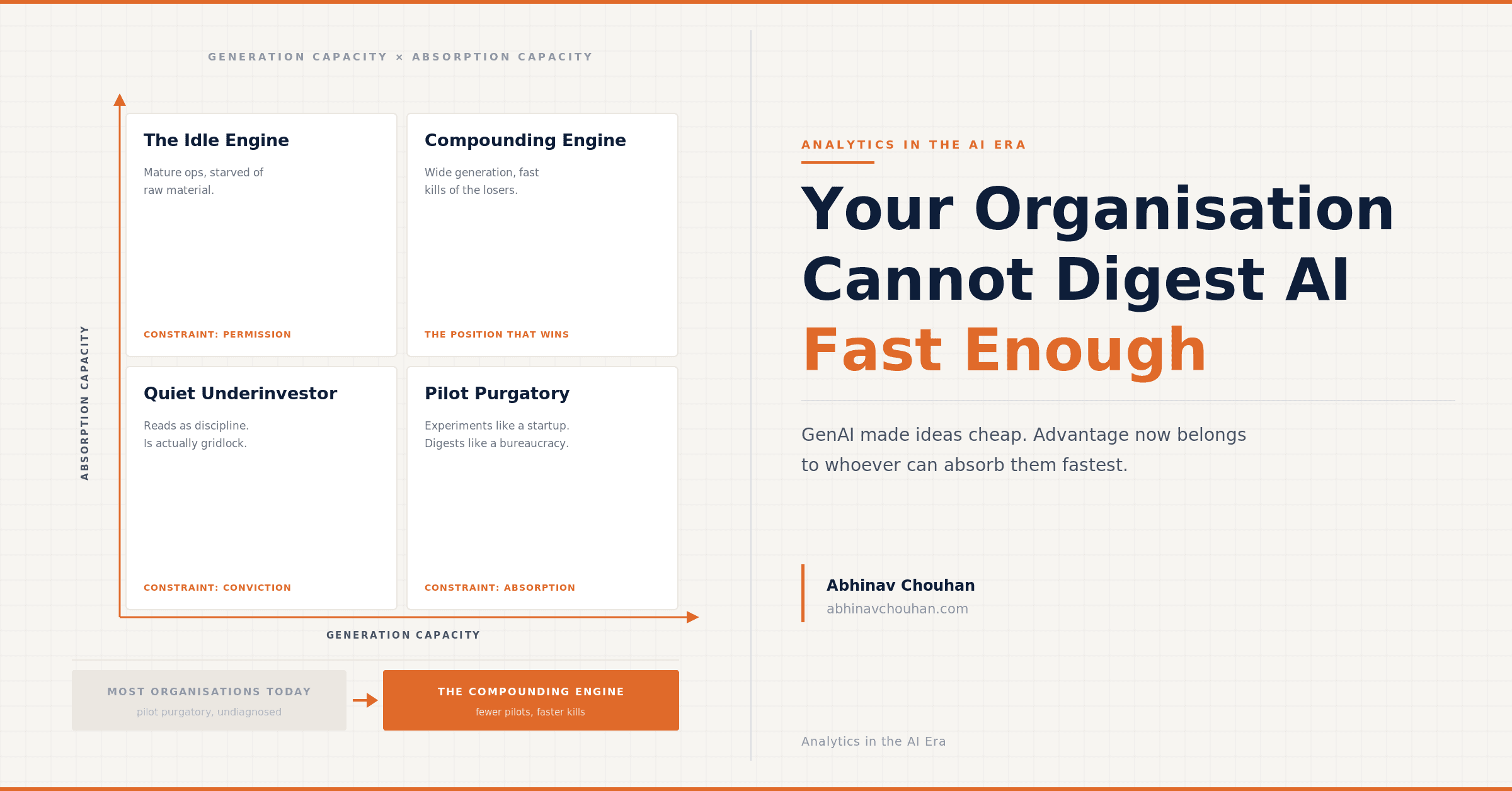
Insight generation and absorption. AI-assisted platforms make it easy to produce more reports, more data cuts, more ad hoc analyses. Supply of analysis increases. Decision-maker capacity to absorb and act on it does not. The result is insight debt: a growing backlog of unconsumed analysis, with decision-makers feeling buried and analysts feeling ignored. The constraint was never at the production end. Addressing it means redesigning how insights reach decision-makers, not accelerating how many are produced.
Agentic analytics pipelines. When AI moves from augmenting analyst work to replacing it, the bottleneck migrates further. It moves to accountability. Who owns the output? How is it validated before it reaches a decision-maker? When the agent surfaces a finding that contradicts a business owner's instinct, what is the resolution process? When it is wrong, who is responsible? These are not technical questions; they are governance questions. Deploying agentic analytics without answering them does not remove the bottleneck. It replaces it with an accountability gap that has no owner.
Each of these scenarios exposes a different layer of the same underlying problem. Individual productivity converts to enterprise value only when three conditions hold simultaneously, and in most analytics functions at least one of them is missing before deployment begins.
Three conditions the gain depends on
Diagnose the real constraint. The diagnostic question for analytics is not "where can AI make us faster?" It is: what constrains the analytics function's ability to drive decisions? In most analytics functions, that constraint is not analysis production. It is the gap between insight generated and insight acted upon: decision-maker bandwidth, trust in the output, and the process for converting findings into commitments.
AI must address the actual constraint on system throughput, and the workflow must be rebuilt around that constraint. These are sequential steps: diagnose first, redesign second. McKinsey's data is specific: fundamental workflow redesign is the single attribute most correlated with EBIT impact from AI, and only 21% of organisations using generative AI have done it. Inserting AI at one production step while leaving the consumption workflow unchanged is acceleration of the wrong thing.
Map the entire flow from data source to business decision before selecting a tool. For every AI investment, define the end-to-end workflow change. If the consumption steps are not redesigned to absorb increased output, the investment will produce insight debt. An AI investment proposal that cannot describe the end-to-end workflow change should not be approved.
Establish accountability before deployment. A 2025 study of US manufacturing firms found that established companies, upon adopting AI, began neglecting the KPI monitoring, target-setting, and operational discipline they had previously maintained. That abandonment alone accounted for nearly one-third of their productivity losses. The problem was not that these firms started poorly managed. It was that implementation attention crowded out the disciplines that had made them productive in the first place.
For analytics functions, this risk operates on two levels simultaneously. The first is operational: the function's own accountability infrastructure — outcome monitoring, decision attribution, performance targets — can quietly erode during the demands of a rollout. The second is structural: AI-assisted and agentic outputs introduce accountability gaps that have no prior precedent and do not resolve on their own after deployment.
Before deploying, assess whether analytical outcomes are being monitored, targets are clear, and there is accountability for whether findings drive decisions. Fix gaps before deployment begins. Any decline during implementation is an early warning signal, not a tolerable side effect. For every analytics output where AI materially shapes the finding, name who validates it, how, and who is accountable. For agentic use cases, the accountability question becomes binding: who validates the output, who is responsible when it is wrong, and what the resolution process looks like when a finding contradicts a business owner's judgment. An accountability gap with no owner is not a technical problem waiting for a technical solution; it is an organisational decision that has been deferred.
Name where freed capacity goes. Time saved is invisible in financial statements. An analyst who writes queries 50% faster and fills the freed hours with lower-priority requests has not increased enterprise productivity. The conversion has to be defined before deployment: does freed capacity produce more business coverage, higher-complexity analysis, faster turnaround on priority work, or reduced headcount cost? Whether the answer is more coverage, faster turnaround, or reduced headcount matters less than having a named answer. Without naming the conversion, the gain stays personal. Review it quarterly. If freed capacity is not producing the named outcome, treat that as a redesign failure, not a tool problem.
The data from three years of enterprise AI deployment is consistent enough to read clearly. Individual productivity gains from AI are real. Enterprise productivity gains require something more: the diagnosis, accountability structures, and deliberate conversion of freed capacity that historical technology cycles required before them.
Analytics leaders have an advantage here. They understand pipelines, bottlenecks, and the gap between output and outcome better than most of their executive peers. The functions that close the gap will not be the ones with the most AI tools or the broadest deployment. They will be the ones that treated individual speed as a raw material and built the conditions to turn it into something the business can use.
The analysts are getting faster. The question is whether the organisation is designed to use that speed.
If this was useful, Analytics in the AI Era goes deeper on questions like this every week. Analysis grounded in what is actually happening, applied to the work of leading data and analytics teams.
Subscribe here; free, and you can leave at any time.
If any of this connects to something you are working through, I would love to compare notes. Reach out.