Somewhere in your organisation right now, a working AI prototype is quietly dying. It solves a real problem. The demo impressed the right people. Nothing is wrong with it. It is dying anyway, because ahead of it in the queue sit a dozen other working prototypes, and behind all of them sits an organisation that can genuinely absorb perhaps two significant changes a quarter.
For decades, leadership teams have asked how much effort should go to exploring new ideas versus exploiting proven ones, and the answer has always been a simple ratio: 70 (on core offerings) : 20 (on adjacent efforts) : 10 (on transformational bets). In the GenAI era, that question has quietly become obsolete, because it assumes the scarce resource is the capacity to generate ideas. Generation is no longer scarce. A working demo that once took a data science team a quarter now takes an analyst an afternoon. The scarce resource, the one that now sets the pace of everything, is your organisation's capacity to absorb what it generates.
GenAI increased experimentation capacity by an order of magnitude and left absorption capacity almost exactly where it was. Every stalled pilot, every abandoned proof of concept, every innovation programme that produces motion without progress is downstream of that single asymmetry. Organisations keep treating it as an innovation problem and funding more generation. It is a digestion problem, and more generation makes it worse.
Every wave moves the bottleneck
Technology waves follow a reliable pattern: each one makes something cheap, and advantage moves to whatever stays expensive.
Computing made calculation cheap, and advantage moved to the people who could turn calculation into software. The internet made distribution cheap, and a wealth of information created a poverty of attention. Cloud made infrastructure cheap, and the scarcity moved up the stack to engineering talent and product judgment. In every wave, the organisations that struggled were the ones still optimising for the old scarcity, hoarding what had just become abundant while starving what had just become rare.
GenAI made the journey from idea to working prototype cheap. A wealth of prototypes now creates a poverty of absorption. The explore-exploit ratio was a tool for rationing expensive experimentation. Rationing something that costs almost nothing is answering a question the world stopped asking.
What absorption actually is
Absorption capacity is everything that has to happen between a working demo and a changed organisation. Data governed enough to trust. Integration with systems that were never designed to receive it. Workflows redesigned around a new way of working. A business owner willing to answer for the outcome. And the hardest constraint of all: the finite attention of the people whose daily work the change disrupts. None of this got cheaper when prototyping did. Most of it cannot get dramatically cheaper, because most of it is made of human trust and human attention, and those do not scale with compute.
Seen this way, every prototype is a claim on your organisation's future attention. GenAI made those claims cheap to produce and did nothing to increase the attention available to meet them. That is why the pilot boom feels like acceleration and gridlock at the same time.
The numbers behave exactly as this account predicts. Depending on whose study you read, somewhere between 5% and 12% of enterprise AI pilots reach durable production use. More telling is that the ceiling predates GenAI entirely: surveys of data scientists in 2020 found only around 13% saying their models were consistently deployed. The conversion ceiling did not move when AI arrived, because the ceiling was never made of technology. It is made of absorption, and cheap prototyping just means more attempts hit it faster.
The absorption gap, mapped
Map generation capacity against absorption capacity and the failure modes that get discussed as separate diseases turn out to be quadrants of the same condition.
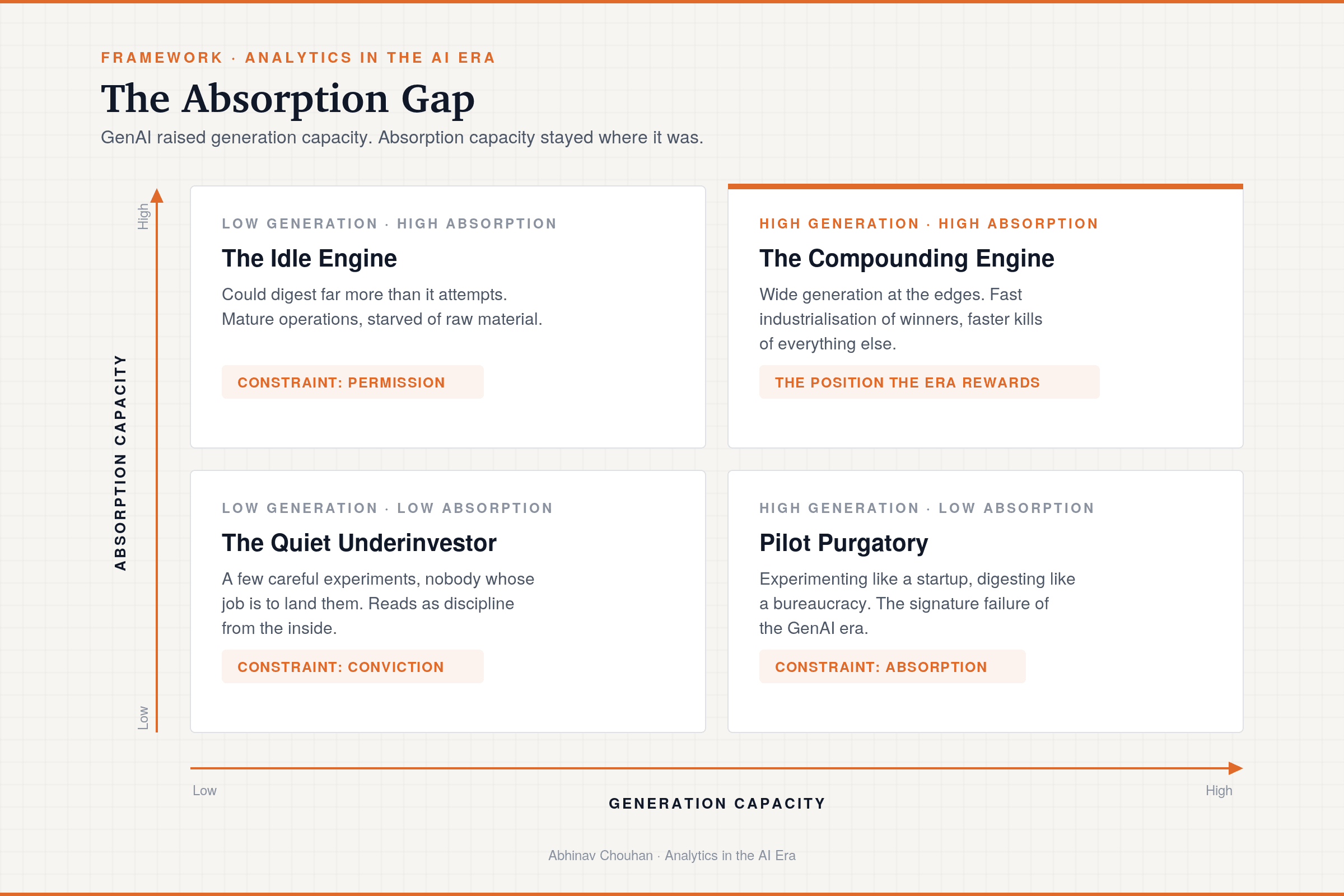
Pilot Purgatory is high generation, low absorption: the signature failure of the GenAI era, and the one that photographs best in a board pack. Dozens of pilots, nothing graduating, the same undiagnosed absorption gaps killing each new cohort. These organisations are experimenting like startups and digesting like bureaucracies.
The Idle Engine is the inverse: real absorption capability, mature governance, disciplined operations, and too little generation to feed it. This organisation could digest far more than it attempts. Its constraint is permission.
The Quiet Underinvestor is low on both axes, and usually convinced it is being prudent. In my experience this is where many established organisations settle: a small number of carefully scoped experiments, approval processes tuned for a slower era, and nobody whose job is to land the few things that do get built. From the inside it reads as discipline. From the outside it is a standing decision to keep things safe while competitors learn at a different speed, and because the cost never appears on a risk register, nothing ever forces that decision to be revisited.
The Compounding Engine is the position the era rewards, and it rests on a distinction the other quadrants blur. A prototype costs almost nothing until someone decides to scale it. A pilot is a prototype that has started drawing on your absorption budget. The Compounding Engine runs wide at the prototype stage and ruthless at the pilot stage: many cheap probes at the edges, few formal pilots, fast industrialisation of the winners, and faster kills of everything else. The kill decision matters more than it first appears, because in a world of abundant prototypes, killing is how absorption capacity gets reallocated. An unkilled pilot is a slow leak in your scarcest budget.
The reason this framing beats the ratio is that the two axes need opposite interventions, and a ratio cannot tell you which one you need. Low generation is fixed with permission and cheap tooling. Low absorption is fixed with named ownership, enforced kill dates, and investment in the unglamorous infrastructure that makes change land.
Four questions instead of a ratio
If the ratio conversation surfaces in your next planning cycle, replace it with these.
- How many changes did you fully absorb in the last twelve months? Count the pilots that reached durable production use. A number, from memory, without a slide. Most leaders cannot produce one, which is itself the diagnosis.
- Who owns the path from demo to production? Individual pilots have sponsors. The pipeline they all travel through usually belongs to nobody.
- How long does a failing pilot take to die? And where do its people land next? If nobody can answer, your kill mechanism is decorative and your absorption budget is leaking.
- For every dollar you spend generating ideas, what do you spend absorbing them? Data readiness, integration, workflow redesign. The spending mix, honestly examined, tells you which scarcity your organisation still believes in.
Analytics leaders have already lived this
If this diagnosis sounds familiar to you as a data and analytics leader, it should. Your function ran this experiment a decade before the rest of the enterprise. Models that were easier to build and brutal to deploy, demos that impressed executives and then dissolved on contact with production data, a 13% deployment rate that nobody outside the function considered a strategic problem. The rest of the organisation is now living inside the problem analytics teams have been quietly managing for years. GenAI did not create the absorption gap. It made the absorption gap everyone's problem at once.
That history is an asset, because the discipline analytics teams built under that pressure is absorption infrastructure by another name. Governed definitions that make a number mean the same thing in every room. Deployment and monitoring practices that keep a model trustworthy long after the demo. A semantic layer that turns a probabilistic answer into one a CFO can act on. And the slowest, least visible work of all: earning enough trust that a business owner will put their name against a system they do not fully understand. None of it was built with GenAI in mind, and all of it is precisely what GenAI now depends on. The demo can be built in a week; whether it can be absorbed depends on what sits underneath it.
Which suggests where analytics leaders should stand in this cycle. The instinct will be to compete on generation, shipping more AI demos to stay visible. The stronger position is to become the organisation's authority on absorption: the function that knows, from scar tissue, what it takes to move a probabilistic system into production and keep it trusted. In an enterprise drowning in prototypes, the person who can say which ones the organisation can actually digest holds the scarcest expertise in the room.
The metabolism advantage
Zoom all the way out and the strategic implication is hard to escape. For as long as ideas were expensive, competing on generation made sense; the firm with more experiments learned faster than the firm with fewer. Now every competitor has access to the same idea machine, at the same price, improving at the same rate. When everyone can generate, generation confers no advantage.
Advantage moves to absorption: the speed at which an organisation can absorb a validated idea, operationalise it, and redeploy the freed people and capital into the next one. The single number that captures it is kill-to-redeployment speed, the time between deciding a pilot is dead and the moment its budget and its people are productive on the next bet. It is the one measure that exercises the whole system, and almost nobody tracks it.
Generation capacity can be bought; it arrives with the subscription. Absorption capacity has to be built, change by change, and it compounds with every idea it successfully digests. That difference in how the two capacities accumulate is the quiet answer to where moats come from in the AI era. Over the next decade, the winning organisations will likely run more prototypes and fewer pilots than their competitors, and ship more than both, because they stopped asking how much to explore and started asking a harder question: how fast can we digest what we already know works?
Feed your organisation at the pace of its metabolism, and invest everything you can in raising it.
If this was useful, Analytics in the AI Era goes deeper on questions like this every week. Analysis grounded in what is actually happening, applied to the work of leading data and analytics teams.
Subscribe here; free, and you can leave at any time.
If any of this connects to something you are working through, I would love to compare notes. Reach out.