The question most people are asking about generative AI is the wrong one. "Will AI disrupt my industry?" is already settled. The more useful question is: why does GenAI land so differently across domains? Why does it substitute aggressively in software development and marketing execution, while clinical diagnosis and high-stakes legal strategy remain largely unchanged? For data and analytics leaders, that question lands with particular force; the answer is more complex, and more consequential, than it first appears. Why does one domain look transformed in 18 months while another looks essentially the same?
The answer follows a predictable logic. How generative AI integrates across industries is not random, and not driven purely by how mature the technology is. Two underlying variables govern where GenAI lands in any domain, and understanding them gives you a map that works across industries, including the one you lead.
Two variables predict where AI lands in any domain
Variable one: output codifiability.
Codifiability refers to the extent to which a task can be decomposed into explicit, rule-following procedures. Some tasks are fully codifiable: boilerplate code, clinical notes in a standard format, copy variants, test cases. These can be specified as rules or patterns. GenAI can take them over cleanly. Other tasks are weakly codifiable: strategic acquisition decisions, novel clinical diagnoses, brand positioning in an untested market. These require judgment that resists algorithmic specification. The knowledge that drives them is tacit, contextual, and emergent.
Codifiability determines how much of a task GenAI can own. Where codifiability is high, substitution is immediate and measurable. Where it is low, augmentation is the ceiling — at least for now.
Variable two: cost of error.
This is not purely financial. It encompasses reversibility, accountability, regulatory consequence, and institutional liability. Design iterations carry low error cost; you can try ten directions in an afternoon and discard nine. A clinical treatment decision carries very high error cost: a wrong output causes direct patient harm and carries professional and legal consequence.
Where error cost is low, the system trends toward substitution and then toward agentic autonomy. Where error cost is high, governance, regulation, and liability keep humans structurally in the loop, often regardless of how capable the model becomes.
Four postures, not a spectrum
Plot codifiability against error cost and four distinct postures emerge. Not a dial, not a gradient; four structurally different situations that call for structurally different responses.
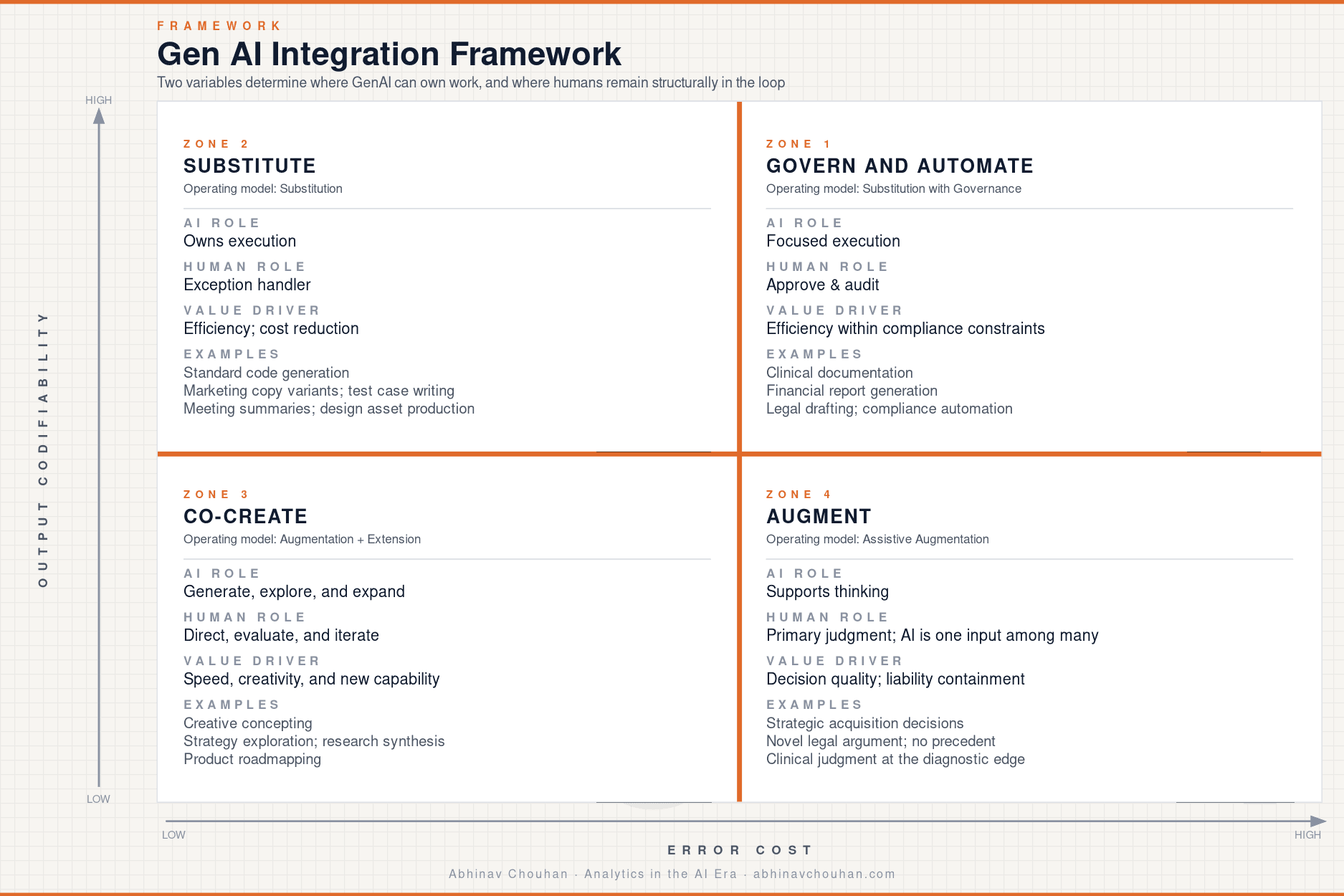
Substitute (high codifiability, low error cost). This is where substitution happens first and fastest. Standard code generation, marketing copy variants, test case writing, design asset production, meeting summaries. The output can be fully specified, a wrong answer has low consequence, and iteration is cheap. This posture migrates quickly toward full agentic autonomy. The human shifts from executor to reviewer to exception handler.
Govern and automate (high codifiability, high error cost). The model can do the work, but human oversight is structurally mandated. Clinical documentation, financial report generation, legal drafting, compliance automation. AI executes; a human ratifies. The bottleneck here is institutional trust and regulatory permission, not model capability. As error rates are empirically validated over time, the ratification requirement gradually relaxes.
Augment (low codifiability, high error cost). GenAI approaches this posture last and most cautiously. Strategic acquisition decisions, novel legal argument with no precedent, clinical judgment at the edge of diagnostic knowledge. The task requires tacit judgment that resists specification, and errors carry real consequences. Human judgment is structurally required here.
Co-create (low codifiability, low error cost). The output cannot be pre-specified, but mistakes are recoverable. Creative concepting, strategy exploration, research synthesis, product roadmapping. AI accelerates ideation; the human curates and directs. The value is velocity and range of exploration.
Co-create is also where the most frequently overlooked opportunity appears: AI enabling work that was previously infeasible at any cost. Hyper-personalised content at consumer scale. Real-time clinical documentation at every patient interaction. On-demand legal research for individuals who could never previously afford it. Ambient analytics that surfaces insight continuously rather than on request. This is not about doing existing work faster; it is about opening work surfaces that did not exist before.
Here is what the map shows
Before looking at where specific domains land, one thing is worth naming explicitly: most domains are not in a single posture. They are a portfolio of sub-tasks, each sitting somewhere different on the map. The table below shows the centre of gravity, where the majority of current work in each domain concentrates. But within every domain, sub-tasks are distributed across the framework, and the distribution matters. Where exactly your work sits within a domain is more actionable than knowing the domain-level answer.
Data and analytics is the clearest example of this, and gets its own section below.
| Domain | Primary posture | What gets substituted | What stays with humans | Extension opportunity |
|---|---|---|---|---|
| Software development | Substitute / Govern and automate | Boilerplate, tests, documentation | Architecture, domain-specific logic | Agentic development pipelines |
| Design and creative | Substitute / Co-create | Asset production, layout iterations | Conceptual direction, brand judgment | Personalised creative at consumer scale |
| Marketing and content | Substitute / Govern and automate | Copy variants, email drafts, asset generation | Strategy, tone, audience insight | Always-on, hyper-personalised content engines |
| Legal services | Govern and automate | Document drafting, standard research | Novel argument, professional accountability | On-demand legal access for individuals |
| Healthcare | Govern and automate / Augment | Documentation, administrative coding | Clinical diagnosis, ethical judgment | Ambient documentation at every care interaction |
| Data and analytics | Substitute / Augment | Reporting, pipeline code, EDA, dashboard generation | Causal interpretation, problem framing, strategic inference | Analytics-informed reasoning for non-technical decision makers |
Each domain follows the same structural shape: a substitution layer, an augmentation residual where human judgment remains necessary, and an extension surface that GenAI opens for the first time. What differs is the speed at which this plays out. Software development and marketing execution are moving fast; expect the current posture to look materially different within 18 months. Healthcare clinical judgment and legal strategy are moving slowly, held back by governance and liability rather than model capability. Data and analytics sits between these poles, with execution moving fast and interpretation moving slowly. That separation is where the most consequential function design decisions are currently being made.
Analytics is not one posture. It is several, moving at different speeds.
Data and analytics is a broader vertical than a single posture can capture, which is precisely what makes it worth mapping in detail. Different sub-disciplines sit in genuinely different parts of the framework, and postures are shifting at different speeds within the same function.
The standard reporting and dashboarding layer, covering the production of scheduled reports, KPI dashboards, and templated performance summaries, sits firmly in the Substitute posture. The work is highly codifiable: data is specified, metrics are defined, formats are standardised. GenAI can generate dashboard narratives, produce written summaries of performance data, and automate the construction of recurring reports with low error consequence. The substitution here is already underway.
Customer analytics and marketing analytics follow a similar pattern at the execution layer. Segmentation runs, campaign performance analysis, attribution modelling, A/B test summarisation: these are codifiable at the mechanics level, and the first-draft versions of this work are being accelerated significantly by AI tooling. The error cost for a draft-level segmentation or a first-pass attribution analysis is recoverable, which means this layer moves into the Substitute posture quickly.
The interpretive layer sits differently. Causal inference, understanding why a metric moved rather than just that it moved, requires domain knowledge, contextual judgment, and an understanding of confounding factors that no model currently owns reliably. This is Augment territory. The stakes are real: a causal misread driving a significant budget reallocation or a product decision is a high-error-cost outcome, and the accountability sits with the analytics function. The same applies to problem framing: deciding which question to ask before any analysis begins, and whether the available data can actually answer it, requires the kind of judgment that model capability has not yet approached.
Insight generation and analytics storytelling sit in the Co-create posture: the model accelerates the synthesis and the drafting, but the human remains the author of the interpretation. AI can surface patterns; it cannot yet determine which pattern is consequential for a specific business context.
The extension opportunity for data and analytics is significant and underappreciated. GenAI makes analytical reasoning accessible to non-technical decision makers in ways that were previously infeasible at scale. The function that architects this well, with AI handling the production layer and analytics expertise concentrated at interpretation, framing, and strategic inference, is genuinely different from the function that simply automates its existing workflows.
The map works. It also moves.
The framework above tells you where a domain, or a sub-task within a domain, sits today. There is a variable it does not yet account for: where each posture is headed, and how fast.
The critical point here is what the trajectory does not mean. It does not mean low-codifiability tasks become more codifiable over time. The underlying task structure does not change. What changes is the model's ability to approximate tacit judgment without ever making it fully explicit.
Traditional automation required you to codify a task before automating it. You had to write the rules down. If the knowledge was tacit or contextual, the task was safe from automation.
GenAI breaks this assumption. It does not require explicit codification. It learns a statistical approximation of output patterns from vast observed human behaviour. The task never becomes codifiable in the classical sense, but the model develops something that functions like tacit judgment within the distribution of cases it has seen.
The practical implication: every task has a distribution of instances, from the routine to the genuinely novel. What improving model capability does is extend the model's reliable range further toward the novel end of that distribution. Consider radiology: models trained on hundreds of thousands of labelled scans learned to approximate diagnostic pattern recognition without those patterns ever being written as rules. The radiologist now reviews AI-flagged cases rather than reviewing every image from scratch. The routine distribution is handled; the radiologist concentrates on the ambiguous tail. As that tail shrinks, the job changes fundamentally without the underlying task ever becoming more codifiable.
Two variables drive the speed of this shift. On the supply side: model capability improvements, scale, fine-tuning, multimodal capability, and reasoning advances. On the demand side: error tolerance by domain, shaped by regulation, liability, institutional trust, and the cost of oversight. These forces are in constant tension. In most high-stakes domains, the model is capable enough before the institution is willing to remove the human.
Postures are not permanent. A sub-task in the Govern and automate posture today may migrate to Substitute as trust is established empirically. A task in Augment may shift as model capability closes the gap between routine and novel cases. The map is a snapshot, and the snapshot has a short shelf life in some domains.
What the map is asking of you
One assumption this framework challenges directly: the traditional task-automation model predicted that AI picks off tasks one at a time, leaving the function intact as a coordination layer around the remaining work. An analytics team loses the report-generation subtask; the analytics function persists, reorganised around what is left.
Agentic AI changes this at the architectural level. An agent does not handle one subtask and hand control back. It pursues goals across multiple steps, calls tools, adapts as conditions change, and executes complex multi-step workflows with limited supervision. For analytics leaders, the trajectory is not a background variable to monitor periodically. It is the most urgent input into function design decisions being made right now.
The practical ask is two-part.
First, map at sub-task level. The domain-level view in the table above is the orientation layer. The decision-useful version requires you to identify which specific workflows in your function sit in which posture right now. Not "data and analytics is mostly Substitute and Augment," but which pipelines, which reporting layers, which analysis types, which interpretation tasks. The posture differences within a function are often larger than the differences between functions.
Second, track the trajectory per sub-task, not per domain. Different parts of the same function are moving at genuinely different speeds. Understanding where model capability is closing in on your Augment layer, and whether your organisation's error tolerance is keeping pace or lagging behind, is the most actionable intelligence this framework produces.
Traditional ML and predictive modelling deserves this sub-task treatment in full, and that piece is coming.
The map exists. The question is whether you use it before the territory changes around you.
If this was useful, Analytics in the AI Era goes deeper on questions like this every month. Analysis grounded in what is actually happening, applied to the work of leading data and analytics teams.
Subscribe here; free, and you can leave at any time.
If any of this connects to something you are working through, I would love to compare notes. Reach out.